Home

UK Projects
International Projects
Contractor News
Industry Moves
Contractors'
Guides
Technical Toolbox
Glossary
|
UKAEA To Treat and Reduce Highest Hazard On Dounreay Site
 UKAEA has set out its plans to make safe for future generations one of the most hazardous legacies of the fast reactor experiment at Dounreay. UKAEA has set out its plans to make safe for future generations one of the most hazardous legacies of the fast reactor experiment at Dounreay.
Following public participation in the options, UKAEA has confirmed its intention to solidify liquid waste from the reprocessing of fast reactor fuel using cement instead of glass.
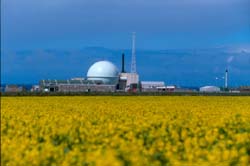 Almost half the radioactive waste hazard at Dounreay is concentrated in this liquor and its conversion to a form suitable for long-term storage or disposal as solid intermediate-level waste is one of the highest priorities of the site restoration plan.
The waste will be transferred from underground storage tanks to a new plant where it will be mixed with cement and set inside 500-litre drums that can be stored safely above-ground pending a national policy for the long-term management of intermediate-level waste.
Subject to regulatory and other consents, construction of the new plant is scheduled to begin in 2007. The first batch of waste is due to be treated in 2012.
Norman Harrison, UKAEA director at Dounreay, said: "Cemententation is a tried and trusted technology for conditioning intermediate-level waste at Dounreay and carries fewer health and environmental risks than vitrification. Innovation in our thinking means we can now reduce the largest single hazard at Dounreay on an earlier timescale and at substantially lower cost to the taxpayer.
"This waste accounts for nearly half of all the radioactivity in our waste inventory at Dounreay, so its conversion to a solid form that can be stored safely and securely in the longer term is one of our highest priorities. Public participation enabled stakeholders to examine and question the rationale behind this strategy, and I'm pleased they have agreed it is the right way forward."
Simon Middlemas, UKAEA's new build manager at Dounreay, said "This plant will be responsible for converting the largest single hazard on the Dounreay site to a form that makes it passively safe for long-term storage or disposal as solid intermediate level waste. Today's announcement about the choice of treatment represents a significant step forward."
Find out more about United Kingdom Atomic Energy Authority (UKAEA)
Search for more UKAEA News
Posted 01/06/05
Back
|